

(Average reading time - 4 minutes)
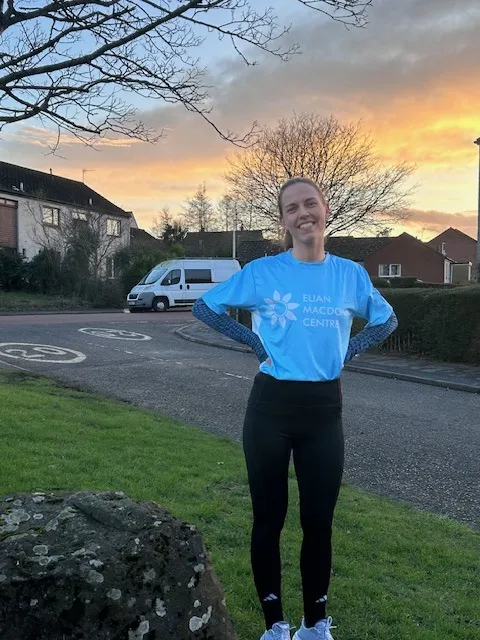
When Anna lines up at the start of the Edinburgh Half Marathon this May, she won’t just be running 13.1 miles. She’ll be running for families affected by motor neuron disease (MND), for young researchers striving to make a difference, and for the hope that science can slow, stop, and ultimately reverse this devastating illness.
At just 28 years old, Anna is already deep into a career dedicated to understanding neurodegenerative disease. Originally from Denmark, she grew up in a small town before moving to Aarhus (Denmark) to study cognitive science — an interdisciplinary degree combining, among others, neuroscience, data science and psychology. Her fascination with the brain led her to Copenhagen, where she completed a rigorous Master’s in Neuroscience.
“It was very tough, with a very high workload,” she recalls — but it was there that her path became clear.
Discovering a Calling
During her master’s, Anna attended lectures by a young neuroscientist, Dr Ilary Allodi, whose work focused on ALS (amyotrophic lateral sclerosis), the most common form of MND, and Anna was captivated.
“That was actually where I first encountered ALS,” she says. “Furthermore, I really enjoyed her teaching style and was fascinated by the work she was doing.”
She reached out, asking if there was a position for a masters' project was available in the lab. There was, and Anna began working on gene therapy research, an important step toward potential treatments in ALS.
After completing her thesis, Anna was offered a PhD position, under the supervision of Dr Allodi and she relocated to Scotland. Now in her third year at the University of St Andrews, her research has expanded to explore the genetic links between ALS and frontotemporal dementia (FTD), two conditions that share the same mutations.
Her work sits within the vibrant collaborative MND research network at the Euan MacDonald Centre.
Through the Centre’s academic afternoons and symposia, Anna has seen first-hand how donations power progress.
“I can see first-hand what kind of work it supports,” she explains. “It’s vital for early career researchers like me.”
Why Fundraising Matters
While Anna has not personally been funded by the Euan MacDonald Centre, many of her colleagues have — including one of her closest friends. And she knows how transformative that support can be.
"Early career research funding is getting increasingly more competitive, she says. "The support allows researchers in the very early career stages to actually do the desperately needed research without having to worry about where the money will have to come from to support it."
That stability matters. It allows scientists to pursue bold ideas, generate vital data, and build careers dedicated to solving diseases like ALS.
“It really gives that push in the early start of your career,” Anna says. “To try out these research avenues.”
Donations don’t just fund experiments. They create opportunities.
“The opportunity is created through fundraisers,” she explains. “It provides new researchers with the first stepping stone, which is immensely impactful.”
A Personal Motivation
For Anna, this work is not only academic.
A member of her husband’s family passed away from ALS just a few years ago. The progression was heartbreakingly fast — around one year from diagnosis.
“It was a very rapid progression,” she says. “Seeing how a person this young can progress so rapidly was hugely impactful.”
Although she didn’t know him well personally, she has come to know the family — and the loss they carry.
“That kind of really brought the personal aspect,” she reflects. “I have a lot of interest in it from a research perspective, but a lot of the motivation also comes from that.”
It is this combination of scientific drive and personal connection that fuels her long hours in the lab — and now, her fundraising effort.
Hopefully we can actually do something to make a difference here.
Taking on the Edinburgh Half Marathon
Anna’s decision to run the Edinburgh Half Marathon began as a family challenge — inspired by her marathon-running mother-in-law.
When she discovered she could run in support of the Euan MacDonald Centre, the decision became simple.
"I thought it was a really good option. To both try out a half marathon, which I really wanted to do, but also try out fundraising. I haven’t done fundraising in that sense before, so I thought it would be a good challenge and bring some extra good with it."
Training hasn’t been without setbacks — a fall earlier this year led to a sprained knee and ankle — but she’s back on track.
“There are still more than 2 months to go, and I have a pretty good base level of fitness and back on my training plan,” she says. “I think I should be good!”
On race day, every step will represent something bigger than the finish line.
Your Support Powers Progress
Behind every breakthrough in motor neuron disease research are people like Anna — early career scientists committing their talent, time and heart to understanding and treating this devastating illness.
But they cannot do it alone.
Donations to the Euan MacDonald Centre enable vital collaboration across Scotland, fund innovative projects, and — critically — give young researchers the stability and opportunity to pursue bold ideas.
By supporting Anna’s fundraising effort, you are:
-
Advancing research into motor neuron disease
-
Supporting the next generation of neuroscientists
-
Giving families hope for better treatments and, one day, a cure
As Anna’s story shows, research is not just data and microscopes. It is personal. It is urgent. And it is powered by people who care.
This May, she will run 13.1 miles.
With your support, her impact can go even further.
To support Anna please donate at her JustGiving page available at:
Relevant links
Find out how you can support us
Be inspired by our supporters stories
The University of Edinburgh Development Trust
The University of Edinburgh Development Trust is a charity registered in Scotland, with registration number SC004307. The Development Trust processes all donations in aid of the Euan MacDonald Centre for MND Research. All the money received through your fundraising will directly support research into motor neuron disease and related conditions. Thank You for your support.
Image courtesy of Anna Stuckert