

(Average reading time 2 mins)
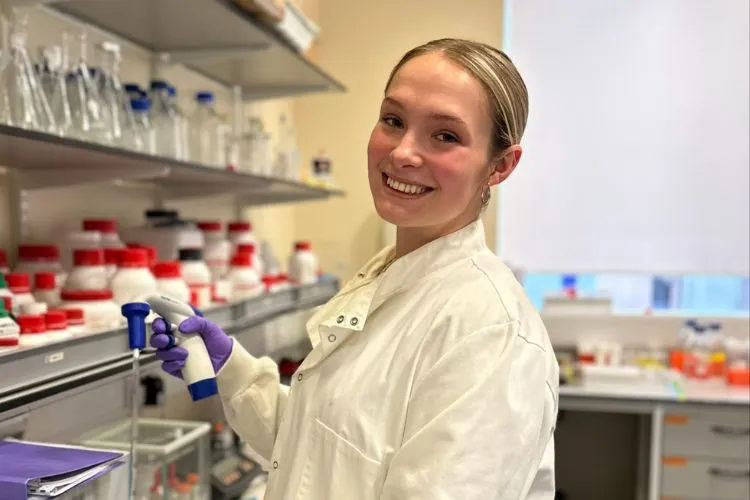
As part of our ongoing series spotlighting our funded PhD students, we are catching up with Alyssa Corbett, now in Year 3 of her doctorate at the University of St Andrews.
How would you describe your project at this stage?
After a few years of learning new research techniques and collecting exciting data, my project is nearing the ‘write-up’ stage. Don’t get me wrong, I’m still spending many days at the lab bench! But while I’m completing experiments to fill remaining gaps and addressing lingering questions, I’m now simultaneously working to compile my data into a manuscript for future publication and assemble my thesis.
What are you currently focusing on in your research?
Throughout my PhD, I’ve been working to understand how astrocytes and neurons are communicating in the early stages of MND. Are they communicating with each other properly? We know neuronal hyperexcitability is a hallmark of neurodegeneration, and we also know astrocytes can help reduce neuronal excitability. Answering these questions and discovering what role they play in MND could provide insights into new potential therapeutic targets.
How has being part of the Euan MacDonald Centre supported your development
Being part of the Euan MacDonald Centre has given me exposure to all aspects of the research pipeline (from benchwork, to drug development, to clinical trial design, to patient care!). This has really allowed me to find where I best fit in the MND research landscape and what aspects of the field energize me most. Above all, in my PhD, this is what I’m most grateful for.
The Euan MacDonald Centre’s regular research events have also given me valuable opportunities to present my work in a supportive but rigorous setting. That practice strengthened my confidence and communication skills, which has helped me excel at conferences and step into leadership roles, including co-chairing the next Gordon Research Seminar on MND. Through these experiences, I have realised how enthusiastic I am about science communication and bringing interdisciplinary groups together.
Are you starting to think about life after your PhD – what would you like to do next?
Yes! I have realised just how passionate I am about the translational side of this field. Alongside my PhD, I serve as Clinical Trials Team Co-Chair at I AM ALS - and act as a Scientific Reviewer at Hop on a Cure - two ALS support organisations based in the USA.
While it’s important you don’t over commit yourself during your PhD, I’ve really enjoyed exploring these other areas of the MND landscape in conjunction with my preclinical research!. These roles have allowed me to engage directly with patients and drug sponsors about trial design and accessibility, while sharing my thoughts on funding strategy, which has opened my eyes to the various ways to be involved in MND research.
After my PhD, I would love to work in a translational role. I’m specifically interested in impacting clinical medical affairs, scientific communications, or a nonprofit focused on accelerating therapies. I want to stay embedded in MND research, but in a position where I can help bridge the science with real-world implementation and ensure discoveries move efficiently, equitably, and urgently toward patients.
Watch this short video from Alyssa about her PhD journey.
Opens University of Edinburgh's Media Hopper. Viewing length approximately 1 min.
Read the introductory article: Training the Next Generation of MND Researchers
Information about the Euan MacDonald Centre
Information about the funded PhD scheme
Information about how you can support us
Image courtesy of Alyssa Corbett