

(Average reading time - 2 minutes)
What was the challenge?
Amyotrophic lateral sclerosis (ALS), a type of motor neuron disease, causes damage to the motor neurons, a type of nerve cell in the brain and spinal cord that control voluntary muscles. This leads to the loss of movement, speech, swallowing, and ultimately, breathing. These cells can extend over a metre in length, and therefore require exceptional amounts of energy to function. They rely on mitochondria, the cell’s energy producing structures, being transported efficiently along the neuron to where energy is needed.
Scientists have shown that two things go wrong in ALS: the transport of mitochondria along motor neurons breaks down, and astrocytes, the brain’s support cells, stop working properly. Astrocytes play a vital role in maintaining the health and energy supply of neurons, but exactly how they influence mitochondrial transport in motor neurons, and whether defects in astrocytes contribute directly to this process, has remained unclear.
What did the team do and what did they find?
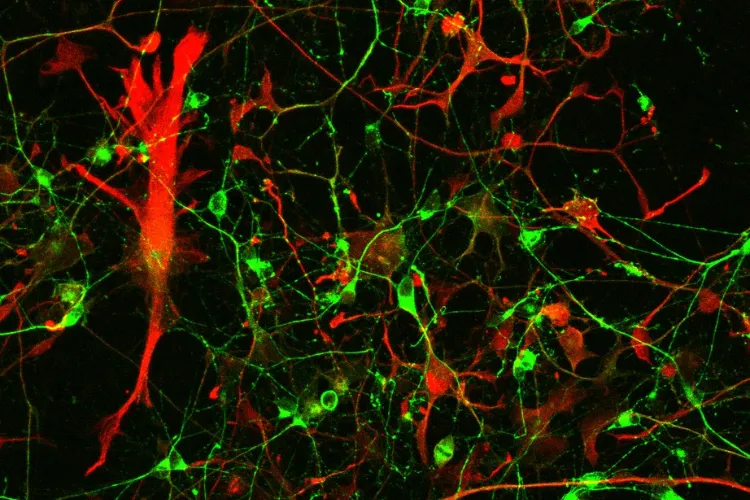
In this study, scientists used stem cells from people carrying the most common genetic cause of ALS (c9orf72) to generate astrocytes and motor neurons in the lab. This allowed them to investigate how diseased astrocytes influence the health and function of motor neurons.
They discovered that astrocytes carrying the ALS genetic change disrupted the transport of mitochondria within otherwise healthy motor neurons, preventing these energy-producing structures from reaching the parts of the cell where they are needed. The team also found that the astrocytes themselves had defective mitochondria. Importantly, when the researchers corrected the genetic fault in the astrocytes, or restored their mitochondrial function (energy production), the motor neurons recovered, and their mitochondrial transport system started working properly again.
Dr Bhuvaneish Selvaraj said:
This study provides an important advance in our understanding of ALS, by identifying a mechanism by which these supporting cells, astrocytes, impact the function of motor neurons. Importantly, we showed that correcting the fault in the astrocytes and restoring their function led to recovery in the motor neurons, suggesting that this could have potential as a therapeutic target.
Dr Maria Stavrou said:
As a clinician, I am acutely aware of the urgent need for more effective treatments for ALS. Our findings show that astrocytes regulate mitochondrial health in motor neurons and open the possibility that therapies targeting astrocytes could protect motor neurons from degeneration, offering a promising new direction for treating this devastating disease.
What is the impact?
These findings reveal a previously unknown mechanism by which dysfunctional astrocytes drive dysfunction in motor neurons. This suggests that therapies targeting astrocytes could help protect motor neurons in ALS.
The study was published in the journal Nature Neuroscience.
This article was originally published by the UK Dementia Research Institute and is also published by the Institute for Neuroscience and Cardiovascular Research, University of Edinburgh.
Related links
Read the full scientific article on the Nature Neuroscience website: “Astrocytes control motor neuronal mitochondrial axonal transport deficits in C9ORF72 ALS”. 10.1038/s41593-026-02464-0
Dr Bhuvaneish Selvaraj’s profile
Euan MacDonald Centre research theme: Understanding motor neurons
Photograph credit: Áine Heffernan, University of Edinburgh